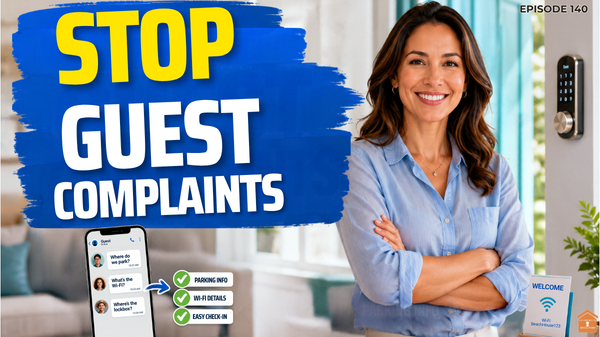
Better vacation rental guest communication can prevent many guest complaints before they ever happen by reducing uncertainty and setting clearer expectations before arrival.
If you’re constantly answering questions about parking, Wi-Fi, check-in or local amenities, a few simple guest communication systems can make the stay easier for your guests and considerably calmer for you.
.
Have you ever received a guest complaint and thought, “I told them that already”?
Parking instructions.
Wi-Fi.
Check-in.
The nearest supermarket.
Sometimes the problem isn’t that you failed to provide the information.
The problem is that the guest didn’t receive it at the moment they needed it.
And that’s where many avoidable complaints begin.
Today, I want to show you how to prevent more of them before your guest even reaches the front door.
.
Hi, I’m Gerry MacPherson.
I’ve spent more than 30 years in hospitality, and I help independent vacation rental and hospitality owners create better guest experiences with simpler systems and less stress.
Last time, we talked about recovering well when a guest has a complaint.
Today, we’re moving one step earlier.
Because the best complaint is the one you never have to solve.
.
In the next few minutes, we’ll look at why expectations cause so many guest frustrations, how repeated questions can expose gaps in your communication, and a simple four-question framework you can use before sending any guest message.
By the end, you’ll have a practical answer to this week’s Cornerstone Question:
How can I prevent guest complaints before they happen?
And thankfully, it doesn’t involve writing a 47-page guest manual.
Nobody wants that.
Especially the guest.
.
THE COMPLAINT THAT WAS REALLY AN EXPECTATION PROBLEM
Let me tell you about David.
David owns a lovely country cottage surrounded by vineyards.
Guests liked the peace, the views and the quiet setting.
Then one afternoon, he received a complaint.
“We’re disappointed there isn’t a supermarket nearby.”
David was puzzled.
His listing clearly showed that the cottage was in the countryside.
There was even a map.
But then he realised something important.
He had explained where the cottage was.
He hadn’t explained what staying there would feel like.
Guests imagined vineyards and peaceful evenings.
They hadn’t imagined driving twenty-five minutes to buy milk.
So David changed a single paragraph.
He told guests that the nearest supermarket was about twenty-five minutes away and suggested buying groceries before arrival.
Nothing about the cottage changed.
The road didn’t move.
Nobody built a supermarket.
But the complaint disappeared.
Why?
Because the expectation changed.
That’s one of the simplest ways to reduce guest complaints.
Tell people not only what they are booking, but what the experience will actually be like.
.
YOUR GUEST EXPERIENCE STARTS BEFORE CHECK-IN
A lot of owners think hospitality begins when someone opens the front door.
It starts much earlier.
The moment the booking is confirmed, the guest begins building a picture in their mind.
Every photograph helps shape it.
Every email adds to it.
Every promise adds to it.
Then the guest arrives and compares the real experience with the one they imagined.
That’s why assumptions can cause trouble.
Guests may assume parking is beside the entrance.
They may assume the Wi-Fi will handle a three-hour video conference.
They may assume there’s a café five minutes away.
Sometimes they’re right.
Sometimes they’re not.
You can’t predict every assumption.
But you can look for the important ones.
Ask yourself:
What would a first-time guest reasonably want to know before arriving here?
That’s a far better starting point than simply sending everything you happen to know about the property.
.
REPEATED QUESTIONS ARE TRYING TO TELL YOU SOMETHING
Here’s where I think many owners make life harder than it needs to be.
You receive the same question for the tenth time.
“What’s the Wi-Fi password?”
And naturally, you think:
“It’s in the welcome guide.”
It probably is.
But if ten guests keep asking, something isn’t working.
Perhaps the guide is too long.
Perhaps the password is buried on page nine.
Perhaps the guest needs that information somewhere else.
Think about road signs.
If one driver misses a turn, the driver may have made a mistake.
If fifty drivers miss exactly the same turn, you might want to have a look at the sign.
Guest communication works much the same way.
Repeated questions are information.
Parking.
Access codes.
Heating.
Rubbish.
Coffee machines.
Departure times.
If the same thing keeps coming up, don’t just create a faster answer.
Try to remove the question.
That could mean moving information.
Adding a photograph.
Rewriting one sentence.
Putting a small sign somewhere obvious.
Small change.
Big difference.
.
What’s the one guest question you seem to answer over and over again?
Parking?
Wi-Fi?
Check-in?
Heating?
Let me know in the comments.
.
REMOVE FRICTION FROM THE ARRIVAL
Now picture your guest arriving after six hours on the road.
It’s getting dark.
They’re tired.
The children are hungry.
Mobile reception has become slightly theoretical.
This is not the moment to make them search through fourteen old emails for a door code.
Arrival should feel simple.
If parking isn’t obvious, show them where it is.
If the entrance is difficult to spot, send a photograph.
If the lockbox is hidden behind a gate, show the gate and the box.
If the nearest supermarket closes early, tell them before they drive past it.
Every unanswered question creates a little bit of friction.
One question won’t ruin the holiday.
But five or six together can change the mood quickly.
Good hospitality often feels effortless because someone did the thinking beforehand.
That’s the system your guest never sees.
They simply feel the result.
.
USE FOUR QUESTIONS BEFORE YOU SEND ANYTHING
Here’s the framework I’d use for almost every guest message.
First:
What does the guest actually need to know?
Not everything.
Just what helps them at that stage of the stay.
Second:
When do they need to know it?
Sending detailed check-in instructions three weeks ahead may sound organised.
But by arrival day, that message is sitting underneath fifteen restaurant confirmations and a photo from Aunt Margaret.
Send important information close to the moment the guest will use it.
Third:
Where will they naturally look for it?
Some information belongs in the booking confirmation.
Some belongs in a pre-arrival message.
Some belongs in your digital or printed guest guide.
And some belongs right beside the thing it explains.
Finally:
How can I make this simpler?
Use shorter sentences.
Clear headings.
Photographs when photographs explain something faster.
Don’t try to sound clever.
Try to be useful.
That’s it.
What. When. Where. Simpler.
Four questions that can save dozens of messages later.
.
GOOD SYSTEMS DON’T MAKE HOSPITALITY LESS PERSONAL
Some owners worry that systems and templates will make the guest experience feel cold.
I usually find the opposite.
If a clear arrival message means you no longer spend your evening explaining parking to five different guests, you get that time back.
Now you can use it for something human.
Perhaps a guest mentions an anniversary.
You can leave a handwritten card.
Someone is arriving for a cycling holiday.
You can recommend a local route.
A family is arriving late.
You can tell them which shop stays open.
Systems remove repetitive work.
You provide the personality.
The guest doesn’t need to see the checklist behind the scenes.
They just notice that things feel easy.
.
HERE ARE YOUR KEY TAKEAWAYS
- Set expectations before arrival
- Repeated questions reveal gaps
- Remove friction before check-in
- Send information when it’s useful
- Simple systems create calmer stays
.
IN CONCLUSION
So let’s come back to our Cornerstone Question:
How can I prevent guest complaints before they happen?
Start with uncertainty.
Look at the questions guests keep asking.
Look at the assumptions they commonly make.
Then ask whether clearer information, better timing or one helpful photograph could remove that uncertainty before it becomes frustration.
You won’t prevent every complaint.
Things will still break.
Weather will still misbehave.
And someone will eventually forget the door code they received ten minutes earlier.
That’s hospitality.
But you can make the guest journey calmer.
And when your guests feel more confident, you usually feel more confident too.
This week’s Guest Recovery Playbook is available through the show notes. It helps you look at guest complaints from both sides: how to respond well when something goes wrong and how to prevent avoidable problems before they happen.
You can also download the 7-Day Vacation Rental Jumpstart for more practical systems to strengthen your vacation rental foundations.
And if you’ve realised that repeated guest issues are really a symptom of a more reactive business, take a look at the free From Chaos to Control Webinar. It’s a natural next step if you want to reduce repeated work and create a calmer operation.
In the next episode, we are starting a new series. We are going to go behind the scenes and look at the systems guests rarely notice but constantly experience.
We’ll talk about housekeeping, maintenance, standard operating procedures and daily workflows, and how those invisible systems quietly shape reviews, repeat bookings and the quality of every stay.
Because guests may never see your checklist.
But they’ll certainly notice when it hasn’t been followed.
If you are interested in more resources to help grow your business, visit Vacation Rental Resolutions.