Many vacation rental owners struggle with pricing, occupancy, and booking gaps because they misunderstand seasonality and react emotionally to normal market cycles.
This simple framework will help you understand seasonal demand, make smarter Pricing decisions, and stop second-guessing your vacation rental Seasonality.
.
Have you ever looked at your booking calendar and wondered what on earth just happened?
Three weeks ago, guests were booking.
Your inbox was busy.
Your calendar looked healthy.
Then suddenly?
Nothing.
- No enquiries.
- No bookings.
- No movement.
You start checking your listing.
You compare yourself to competitors.
You wonder if your prices are wrong.
You start thinking maybe the market has changed overnight.
Here’s the thing.
Most vacation rental owners don’t have a pricing problem.
They have a seasonality problem.
And today, I want to help you understand the difference.
Because once you understand seasonality, you stop panicking every time bookings slow down.
.
Hi, I’m Gerry MacPherson.
I’ve spent more than 30 years working in hospitality and tourism, helping accommodation owners create better guest experiences, improve profitability, and build businesses that create freedom instead of stress.
One thing I’ve learned over the years is this:
The owners who stay calm during slow periods usually aren’t smarter than everyone else.
They simply understand the rhythm of their market.
.
Over the next few minutes, I’ll show you:
- Why seasonality feels more confusing than it really is
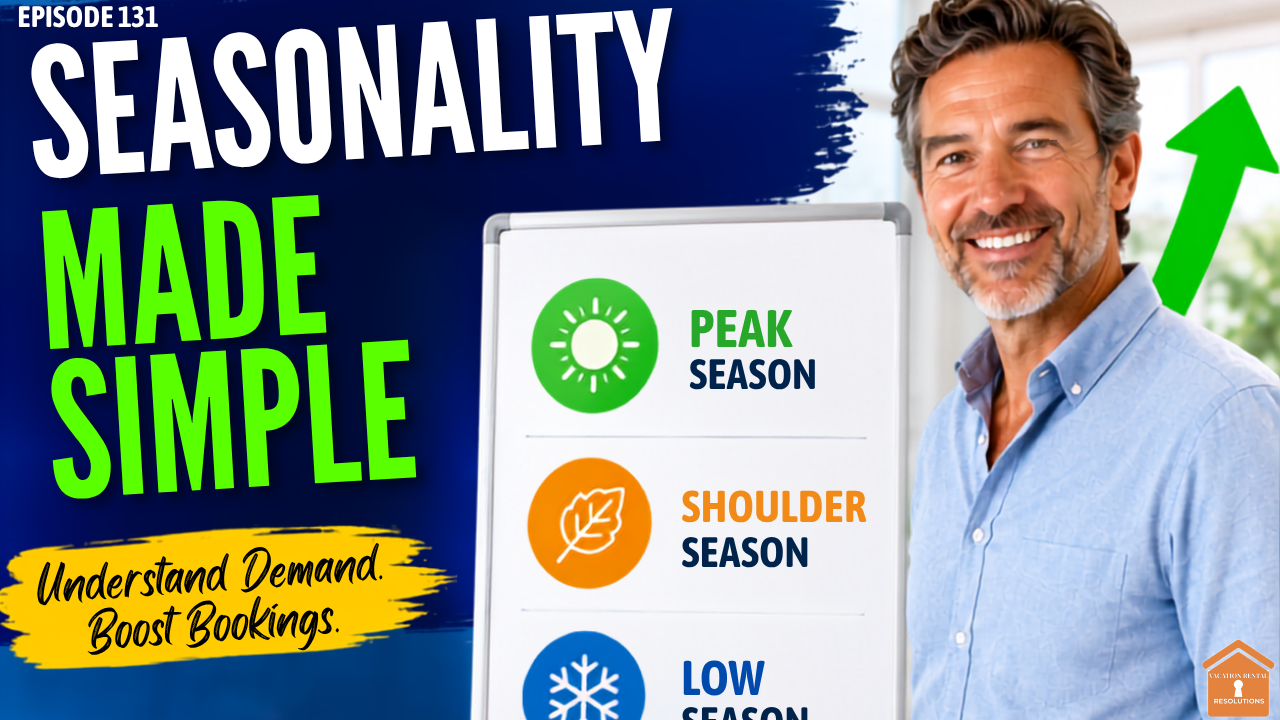
- The three seasons every vacation rental owner should understand
- How to stop making emotional pricing decisions
- How successful hosts plan for slower periods
And by the end, you’ll have a simple framework you can use to make better decisions all year long.
The Real Reason Seasonality Feels So Complicated
Here’s where most people get stuck.
They think seasonality is some mysterious revenue management concept that only large property managers understand.
Honestly, I blame the internet.
Everywhere you look, somebody is talking about algorithms, occupancy curves, forecasting models, and dynamic pricing systems.
Before long, it starts to feel like you need a mathematics degree just to set tomorrow’s rate.
But seasonality is much simpler than that.
Seasonality is simply the predictable rise and fall of guest demand throughout the year.
That’s it.
Think of it like the tide.
The water comes in.
The water goes out.
Nobody stands on the beach panicking because the tide disappeared.
They know it’s coming back.
Bookings work exactly the same way.
.
The Three Seasons Every Host Needs to Understand
This is where it gets interesting.
Most hosts think there are dozens of seasons to track.
There aren’t.
There are really three.
Peak Season
Peak season is your harvest period.
Demand is high.
Guests compete for accommodation.
Rates rise naturally.
For some properties, that’s summer.
For others, it’s winter.
For city rentals, it may revolve around major events.
The mistake many hosts make?
They underprice during peak season because they’re afraid of losing bookings.
That’s like owning a restaurant with a queue out the door and offering half-price meals.
You don’t need to.
Demand is already there.
.
Shoulder Season
Here’s the part most people miss.
Shoulder season is often where the smartest hosts make their money.
Demand softens.
But it doesn’t disappear.
Guests still travel.
They simply travel differently.
Remote workers.
Retirees.
Couples.
Flexible travellers.
Many hosts panic during shoulder season.
Successful hosts adjust their offer instead.
.
Low Season
Low season isn’t a problem.
It’s part of the business.
Every business has quieter periods.
Hotels do.
Restaurants do.
Tour operators do.
Vacation rentals do.
The goal isn’t eliminating low season.
The goal is preparing for it.
.
Stop Comparing Your Property to Everybody Else
Do you know one of the fastest ways to create unnecessary stress?
Comparing your calendar to somebody else’s.
Especially on social media.
One host is posting screenshots of fully booked months.
Another is celebrating record revenue.
Somebody else claims they’re charging double last year’s rates.
Meanwhile, you’re wondering what you’re doing wrong.
Probably nothing.
You’re simply looking at a different market.
- A beach villa in Portugal.
- A cottage in Scotland.
- A cabin in British Columbia.
- A city apartment in London.
Each one operates in a completely different demand cycle.
Their seasonality isn’t your seasonality.
Their strategy isn’t your strategy.
Focus on your market.
Not theirs.
.
Why Occupancy Can Fool You
Now, this might surprise you.
A full calendar doesn’t always mean a profitable calendar.
I know that sounds strange.
But it’s true.
Imagine two hosts.
Host A achieves 95% occupancy.
Host B achieves 75% occupancy.
Most people assume Host A is winning.
Not necessarily.
Host B may charge higher rates.
Host B may attract better guests.
Host B may spend less on turnovers.
Host B may generate significantly more profit.
That’s why successful owners focus on revenue and profit first.
Occupancy matters.
But it’s only one part of the story.
.
The Three Questions Successful Hosts Ask Every Month
Here’s a simple framework from my own approach.
At the beginning of every month, ask yourself three questions.
What season am I entering?
What type of guest is travelling right now?
What offer makes sense for this season?
That’s it.
Simple questions.
Powerful answers.
For example:
Peak season?
Protect your value.
Shoulder season?
Increase flexibility.
Low season?
Get creative.
You don’t need complicated spreadsheets.
You need consistent thinking.
.
Turn Slow Seasons Into Productive Seasons
One of the biggest lessons from the Launch Your First Vacation Rental framework is treating your rental like a business instead of a hobby.
Businesses plan ahead.
They don’t wait for problems.
They prepare for them.
That’s exactly how you should approach seasonality.
When you know a slower period is coming, you can:
- Refresh your photos
- Improve your listing
- Update your guest guide
- Schedule maintenance
- Improve your systems
- Review your pricing strategy
Instead of fearing low season, use it.
Some of your most important improvements will happen when guests aren’t arriving every day.
.
What’s your biggest challenge with seasonality right now?
Pricing?
Occupancy?
Last-minute bookings?
Leave a comment below.
.
Here Are Your Key Takeaways
- Demand moves in predictable cycles
- Learn your three seasons
- Focus on local market patterns
- Profit matters more than occupancy
- Plan ahead instead of reacting
.
If you’d like help putting this into action, download the 7-Day Vacation Rental Jumpstart.
It walks you through building stronger systems, understanding your numbers, improving guest experiences, and creating a more profitable vacation rental business.
It’s practical.
It’s straightforward.
And it’s completely free.
And if you’re ready to build a complete vacation rental business rather than simply manage a property, take a look at the Launch Your First Vacation Rental Course.
Inside the course, I break down operations, guest experience, profitability, systems, pricing, and long-term growth step-by-step.
Thanks for reading.
I hope this helped simplify seasonality and remove some of the stress that comes with running a vacation rental.
Remember, bookings aren’t random.
Markets aren’t random.
Guest behaviour isn’t random.
There are patterns underneath the noise.
Learn those patterns and you’ll make better decisions with far less stress.
And if this article helped, share it with another vacation rental owner who could use a little more clarity.
You don’t need to have it all figured out, you just need the next right step.
Thanks for listening and I’ll see you next time.